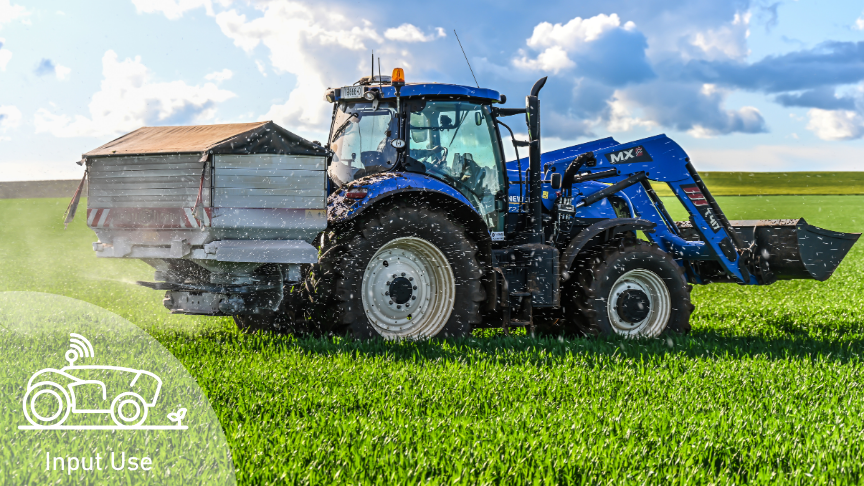
Nitrogen is one of the most essential elements in food production, playing a fundamental role in feeding a hungry world. It is essential for human survival as a building block of amino acids and proteins and critical to photosynthesis in plants. Its use in agriculture is both necessary and challenging, as synthetic fertiliser must be imported and applied annually to sustain crop yields and grain protein, complementing the nitrogen that is available in the soil. Australia is recognised for its responsible and targeted application of fertilisers, resulting in grain production with some of the lowest emissions intensity levels worldwide. However, nitrogen fertilisers represent the highest variable cost for Australian grain growers, squeezing already tight profit margins. With most of Australia’s nitrogen fertiliser imported, growers are exposed to supply chain vulnerabilities, price fluctuations and long-term price increases as the cost of fossil-fuels used to make nitrogen fertilisers continues to rise, making this an ever-increasing challenge for Australian grain growers.
Get your extension right, stay on key message and stop fractured messaging of research results from confusing farmers. Ensure there are nitrogen focussed grains research projects rebuilding expertise and retrain agronomists so they have the confidence to recommend applications.
Looking into Crop Rotation & Application Timing of Nitrogen to get the maximum yield over a 5 year period and the sequence they should follow in an irrigation setting, what is the irrigation doing to the movement of N in the soil. Localised Demos Long term in Irrigation is needed
Quantify N use efficiency across rotations utilising a range of fertiliser and legume N contributions to the system. Relate this back to profit and GHG emissions. This informs growers of options should fert prices increase and/or social expectations around GHG emissions inpact fert usage.
Strategic deep tillage and claying are widely used in WA to ameliorate sandy soils. Quantify the benefits for nitrogen use efficiency through improved root access to nutrients and water. As these operations are energy intensive, evidence is needed to assess productivity gains, carbon footprint and social licence.
Feed the demand – nitrogen and potassium efficiency; As water-use efficiency improves in WA cropping systems, crop demand for macronutrients increases. Potassium availability may increasingly limit nitrogen use efficiency on sandy and weathered WA soils. Quantify N–K interactions to support higher yielding systems.
Reducing N volatilisation on water repellent soils- Large areas of WA cropping soils are water repellent, often remaining dry longer in autumn and spring. This increases volatilisation risk from broadcast urea. Investigate whether amelioration of water repellence improves soil wetting and reduces nitrogen losses.
nitrogen is the highest cost variable input cost most annual cropping farmers have . - we need to better understand volume demand, timing , type of nitrogen for each crop. - we also need better understanding on potential "LOST" production. - still need to better understand high concentration mid row deep banding, is this more efficeint than top dressed N. frequent foliar N applicaitions vs topdressed dry vs uan vs banded N. - interactions with other nutrients for improved efficiency .
Legume Forage - maximising protein production on a per hectare basis. If you look at what grain/fodder enterprise is able to generate the highest yield on a per hectare basis it is from the legume fodders, specifically pea hay. At 21% protein a pea hay crop can generate over 1t/ha of crude protein from circa 280-320mm GSR and 4t/ha of biomass. No grain crop comes close. Obviously the crude protein needs to then cycle through ruminants to be rendered human available.
Quantify benefit of next-gen pasture legumes to supply N & mobilise deep nutrients. Volatility in fert prices highlights the importance of biological N sources. Investment in the mgmt & adoption of improved pasture legumes could increase biological N, reduce reliance on synthetic N & improve system resilience. There could be opportunities to implement legumes that access deep soil nutrients such as K and recycle them into the surface soil, benefiting N use efficiency in the following grain crop
Update and modernise the Nitrogen Wheel / Select Your Nitrogen (SYN) decision-support tool to provide an intuitive, easy-to-use mechanical or digital interface (phone app?). The upgraded tool would allow users to vary key inputs (e.g. rain, soil N, fertiliser/grain prices, potential) to dynamically adjust N decisions. A forward/backward function to enable users explore how changes in N sources alter fertiliser requirements or yields for understanding as well as decision support
localise demonstrations for nitrogen banking, give people the confidence to invest in crops knowing there is a more than 1 year return.
Do local research on the use of foliar nitrogen application, to increase plant uptake, reduce N Losses and wider application window.
Helping to support business' provide transparency in the nitrogen fertiliser markets so growers can make more informed and timely purchasing decisions.
Look at more stable nitrogen fixation technology and bolstering break crop potential to fix N through novel genetics and GM.
R&D for Nitrogen application efficiency to maximise yield and profit
Exhaustive research on biological N inoculation in non-legume crops to harness atmospheric N sources effectively so yield improvements match applied nitrogen
Compare the efficiency of liquid fertilizer against dry fertilizer. Using liquid fertilizer in lateral irrigators for more precise placement and efficient volumes.
Investigate 'Companion Cropping' for N management and herbicide reduction. Suggest planting of clover in cereals and then spraying out in October.
Definitively quantify the nitrogen legacy effect of irrigated legumes and pulses on soils. Is the prevailing view that 'harvested' legumes actually leave a positive nitrogen effect actually true?
Investigate different forms of nitrogen and alternate ways of applying urea ie mixing urea with water and other products to make it more efficient
This is super-important if we are to be able to tick key makret and socety concerns. There has been a very heavy focus on the "synthetic" approach - driven by very short term thinking and the "produce no matter what" appraoch.
Sustainable ecofriendly amendments that improve nutrients including N in the soil
Work with private industry to develop local nitrogen production technology.
Nitrogen losses from tile drainage systems- Tile drainage is expanding in waterlogged WA grainbelt soils. Quantify nitrogen leaching and runoff losses through drainage systems to guide fertiliser management and minimise nutrient export to waterways.
This content is created by the open source Your Priorities citizen engagement platform designed by the non profit Citizens Foundation